
What Size Trash Pump Do You Need to Dewater a Flooded Site?

To dewater a flooded compound or camp, size the pump on three numbers: flow in litres per minute, total head in metres, and the diameter of solids it can pass. A 3-inch Multiquip QP3TH moves up to 1,500 L/min and passes solids to 37 mm; a 4-inch QP4TH lifts that to 2,100 L/min with 51 mm solids. Match those figures to your site before you match a brochure price.
Why is a trash pump the right tool for flood water?
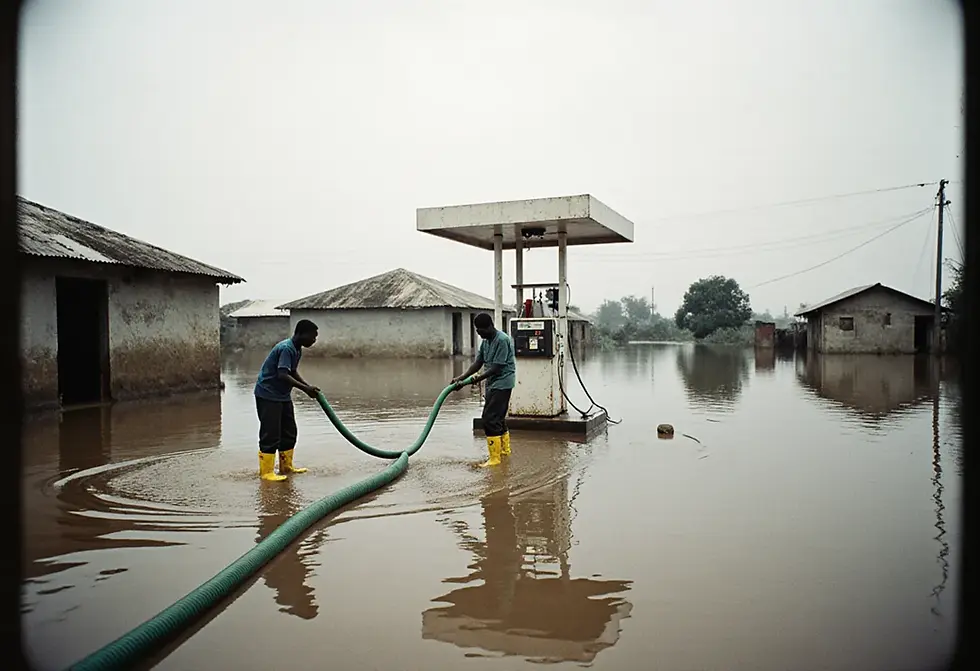
A trash pump is built to move dirty, debris-laden water that would clog or destroy a clean-water pump. Flood water on a displacement site is never clean: it carries mud, leaf litter, plastic and grit. The QP3TH and QP4TH use a semi-open impeller and an oversized casing so they pass solids up to 37 mm and 51 mm respectively, which is the difference between pumping a flooded latrine block dry and burning out a motor in an afternoon. This is not an academic concern in South Sudan, where, as of late November 2024, around 1.4 million people remained flood-affected across 44 counties and Abyei. For the equipment behind that response, see our pump equipment range and our work across South Sudan.
How do I work out the flow I need?
Calculate flow from the volume of standing water and the time you have to clear it. Take the pooled area in square metres, multiply by average depth in metres to get cubic metres, then convert: one cubic metre is 1,000 litres. A 3-inch QP3TH at its rated 1,500 L/min clears 90,000 litres an hour before losses, so a 270 cubic-metre pool drains in roughly three hours at full output. Real-world flow is always lower than the datasheet figure once hose length, lift and debris are in play, so size up rather than to the exact number. Where a single site holds standing water across a wide footprint, two pumps working in parallel beat one pump run past its duty point.
How much head does the pump have to overcome?
Head is the total vertical lift plus friction losses in the hose, measured in metres or feet. The QP3TH carries a maximum head of 95 ft, about 29 metres, and self-primes from a suction lift of 7.6 m; the QP4TH is rated to 92 ft, about 28 metres. Suction lift matters most on a flooded site: if the pump sits on a bund or road and the water sits below it, you must stay inside that 7.6 m suction figure or the pump will not prime. Long discharge runs add friction head, so every extra 50 m of lay-flat hose costs you flow. Plan the pump position first, then the route.
QP3TH or QP4TH: which one for my site?
Choose the QP3TH for compounds, latrine blocks and smaller pooled areas; choose the QP4TH when volume or solids size wins. The 3-inch QP3TH at 1,500 L/min and 37 mm solids handles most compound and facility dewatering and is lighter to reposition. The 4-inch QP4TH at 2,100 L/min and 51 mm solids is the choice for open camp areas, larger debris and faster clearance under a closing weather window. As an authorised Multiquip distributor, we hold both and can advise which suits the site rather than which clears the shelf.
Frequently asked questions
What is the largest solid a 3-inch trash pump can handle? The Multiquip QP3TH passes solids up to 37 mm at a flow of up to 1,500 L/min, which covers the mud, grit and debris typical of flood water on a site.
How fast can a trash pump dewater a flooded compound? At its rated 1,500 L/min, the QP3TH moves about 90,000 litres an hour before friction and lift losses, so a small compound clears in hours, not days, once the pump is sited correctly.
What is the difference between the QP3TH and the QP4TH? The 4-inch QP4TH handles up to 2,100 L/min and solids to 51 mm, against 1,500 L/min and 37 mm for the 3-inch QP3TH; pick the QP4TH for higher volume and bigger debris.
How far can a trash pump lift water from below it? The QP3TH self-primes from a suction lift of 7.6 m; position the pump so the water surface stays within that distance or it will not prime.
Is flood dewatering still a live need in South Sudan? Yes. As of late November 2024, around 1.4 million people remained flood-affected across 44 counties and Abyei, and standing water on sites continues to drive demand for dewatering capacity.
Talk to a supplier who installs what it sells
Specialized Logistics Solutions is the authorised East and Central Africa distributor for Multiquip and Aussie Pumps, so the trash pump you order is genuine, warranted, and backed by in-country installation, commissioning and spares across South Sudan, Kenya, Uganda, DR Congo and CAR. We are a UNGM-registered vendor (No. 380716) with stock and engineers in the region, not a catalogue shipping to a port. Tell us your site and your weather window, and request a quotation for the right pump and the people to commission it.
Comments