
Why Chlorine Disappears Before It Reaches the Cup

Chlorine disappears between the tapstand and the cup because the water keeps consuming it. In South Sudan refugee camps, 40 to 58% of households drawing from chlorinated tapstands had no detectable residual chlorine in their stored water, even though the water left the point of distribution treated. The dose was correct on paper and gone by the time anyone drank it.
What is chlorine demand, and why does the residual fall?
Free residual chlorine is the chlorine left over after the water's "demand" has been satisfied. Add chlorine to water and it immediately starts reacting with whatever is present: organic matter, ammonia, iron, manganese, and the pathogens themselves. Those reactions consume chlorine. Only once that demand is met does any chlorine remain free, available to keep disinfecting and to register on a test. That leftover is the free residual chlorine (FRC) that standards are written around.
The Sphere minimum is a free residual chlorine of 0.5 mg/L after 30 minutes of contact at pH below 8, and 0.2 mg/L at the point of delivery, with turbidity at or below 5 NTU. The problem is that demand does not stop at the tapstand. Stored water in a hot, dusty, frequently re-opened jerrycan keeps reacting, and the residual keeps falling. The decay curve is steepest where the water is warm and the container is dirty, which describes most household storage in a Jonglei or Upper Nile IDP site.
Why does so much water arrive at the cup with no residual at all?
Because the gap between distribution and consumption is where most of the residual is lost, and the standard dose was never designed for that gap. The peer-reviewed finding is blunt: in South Sudan camps, standard chlorine doses could not ensure 0.2 mg/L of free residual chlorine 24 hours after distribution, and 40 to 58% of stored-water samples had no detectable residual. The researchers concluded that the initial target should be raised toward 1.0 mg/L to compensate for the decay that happens in storage.
Several things drive that loss at once:
Heat. Higher water temperatures accelerate chlorine decay. Camp storage water sitting in the sun loses residual faster than the same water in a cool store.
Time. Households collect, then store and draw down over a day or more. The longer the water sits, the more residual has decayed before the last cup is poured.
Recontamination. Dipping a cup or a hand into an open container reintroduces organic load and pathogens, adding fresh demand that eats the remaining chlorine.
Container condition. Biofilm and sediment in a jerrycan that is never properly cleaned exert a continuous chlorine demand.
The result is that a tapstand reading a clean 0.2 mg/L can still feed households whose stored water reads zero by the time they drink it. The test at the point of delivery passed; the water at the cup failed.
Does turbidity make chlorine decay worse?
Yes, and it is one of the largest hidden drivers. Suspended particles both exert chlorine demand and physically shield pathogens from the disinfectant, so cloudy water consumes more chlorine and protects the very organisms the chlorine is meant to kill. This is why dosing has to rise with turbidity. The CDC household standard sets roughly 2 mg/L of chlorine for water below 10 NTU and around 4 mg/L for water above 10 NTU, with a target of at least 0.2 mg/L of free chlorine remaining in stored water 24 hours after treatment.
Treating turbid water with a clear-water dose is a guaranteed way to lose the residual early. The Aquatabs instruction is explicit that cloudy water should be filtered through a clean cloth before dosing, and one 67mg NaDCC tablet is rated for 8 to 10 litres of clear water with a 30-minute contact time. If the source is genuinely muddy rather than slightly cloudy, chlorination alone is the wrong tool and a flocculant-disinfectant is the right one. That product-selection logic sits alongside this decay problem, but the decay problem is real even in clear water.
How do you hold the residual all the way to the cup?
You raise the starting point and you protect the water in storage. Neither alone is enough; together they close the gap the South Sudan data exposed.
Dose for the decay, not just the standard. If a standard dose leaves stored water with no residual after 24 hours, the dose is wrong for that setting. The South Sudan study's own recommendation was to push the initial FRC target toward 1.0 mg/L so that enough remains after a day of decay. Set the target by what the cup needs, then work backward to the dose.
Cut the turbidity first. Filtering or flocculating cloudy water before chlorination removes the demand the particles would otherwise exert, so more of the dose survives as free residual.
Store narrow-necked and covered. Sphere calls for at least two clean 10 to 20 litre collection containers per household, narrow-necked or covered to prevent contamination. A narrow neck stops hands and cups going in and slows the recontamination that drives demand back up.
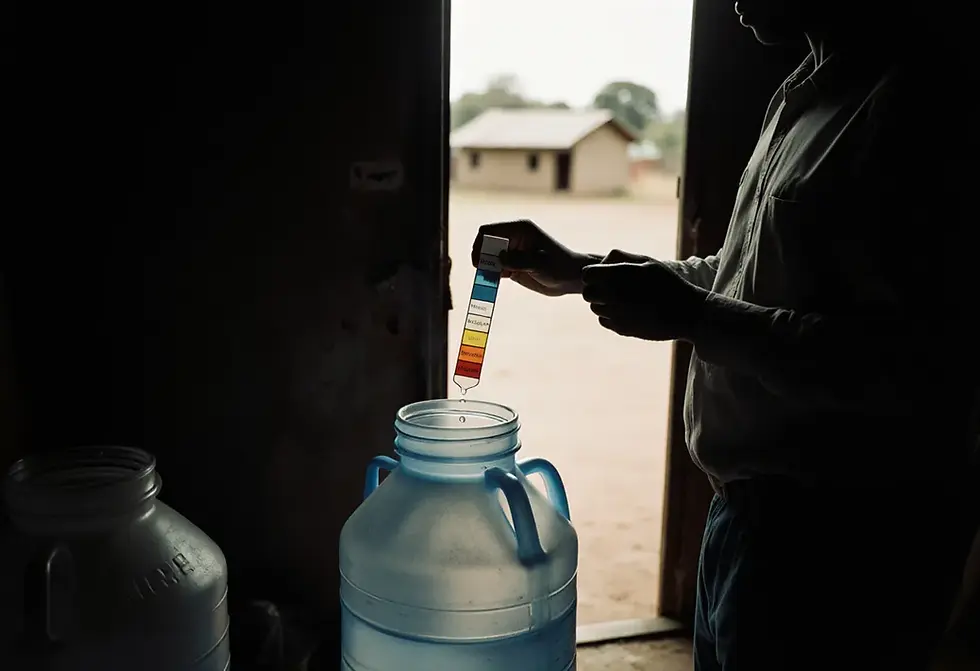
Test at the cup, not just the tap. A residual reading at the point of delivery tells you the tapstand is working; it does not tell you what households are drinking. Testing stored household water is how you catch the failure the South Sudan camps were having.
This matters because the stakes are not abstract. South Sudan's cholera outbreak, declared on 28 October 2024, reached nearly 100,000 suspected cases and more than 1,500 deaths across 55 counties, and safe stored water is one of the few interventions that breaks transmission at the household level. A residual that survives to the cup is the difference between a protected family and a treated container of water that recontaminated overnight.
What does this mean for procurement and dosing in the field?
It means the question "what is the right dose?" cannot be answered at the tapstand alone. The right dose is the one that still reads a protective residual in stored water a day later, which in a hot, turbid, overcrowded setting is higher than the textbook minimum. Plan the chlorine supply around that reality, including a margin for the decay you know is coming, and brief teams to test stored water rather than only the point of delivery.
The supply side has to match. Holding a higher FRC target across thousands of households means more tablets and a chain that does not run dry mid-response, which is exactly the failure mode that loses control of an outbreak. Sourcing authorised Aquatabs 67mg tablets from in-country stock, rather than ad hoc grey-market supply, keeps both the dosing and the residual under control across a long response. For mixed water sources, the wider SLS WASH product range carries the flocculant-disinfectant and testing supplies that complete the source-to-cup chain.
Frequently asked questions
Why does chlorine disappear from treated water before people drink it?
Because the water keeps consuming chlorine after treatment. Heat, time, recontamination from open containers, and turbidity all exert ongoing chlorine demand, so the free residual decays in storage. In South Sudan camps, 40 to 58% of households had no detectable residual in stored water despite drawing from chlorinated tapstands, per the Bulletin of the World Health Organization.
What free residual chlorine should water hold 24 hours after treatment?
At least 0.2 mg/L of free chlorine in stored water 24 hours after treatment is the household benchmark, per the CDC guidance on making water safe in an emergency. The Sphere minimum is 0.5 mg/L after 30 minutes of contact and 0.2 mg/L at the point of delivery, per Sphere WASH standards.
Should I raise the chlorine dose to compensate for decay?
Often yes. Where standard doses could not hold 0.2 mg/L 24 hours after distribution, researchers in South Sudan recommended raising the initial target toward 1.0 mg/L, per the Bulletin of the World Health Organization. Set the target by what stored water needs after a day, then dose to reach it.
Does turbidity increase chlorine decay?
Yes. Suspended particles exert chlorine demand and shield pathogens, so cloudy water consumes more chlorine. The CDC dosing reflects this with roughly 2 mg/L for water below 10 NTU and around 4 mg/L above 10 NTU, per the CDC guidance on making water safe in an emergency. Filter or flocculate turbid water before chlorinating.
How do I stop stored water from losing its residual?
Dose for the decay, cut turbidity before chlorinating, store water in narrow-necked or covered containers, and test stored household water rather than only the tapstand. Sphere recommends at least two clean 10 to 20 litre covered containers per household, per Sphere WASH standards.
Specialized Logistics Solutions is an in-country distributor based in Juba, an authorised distributor for Aquatabs (Medentech/Kersia), P&G Purifier of Water, and Oxfam tanks (Butyl Products), and a UNGM-registered vendor (No. 380716). SLS deployed more than 52 million Aquatabs tablets, a treatment capacity exceeding 1 billion litres, in the 2024-2025 South Sudan cholera response, so we can keep a higher residual target supplied across a long outbreak. Request a quotation from SLS to source authorised chlorine and testing supplies that hold the residual to the cup.
Comments