
What Is Free Residual Chlorine, and What Target Should You Hold in an Emergency?

Free residual chlorine (FRC) is the disinfectant left in treated water after demand is met, and it is what keeps water safe between the tapstand and the cup. The Sphere standard sets it at 0.2-0.5 mg/L: at least 0.5 mg/L after 30 minutes of contact at the treatment point, and at least 0.2 mg/L at the point of delivery. That residual is your continuous protection against recontamination.
What does "free residual chlorine" actually mean?
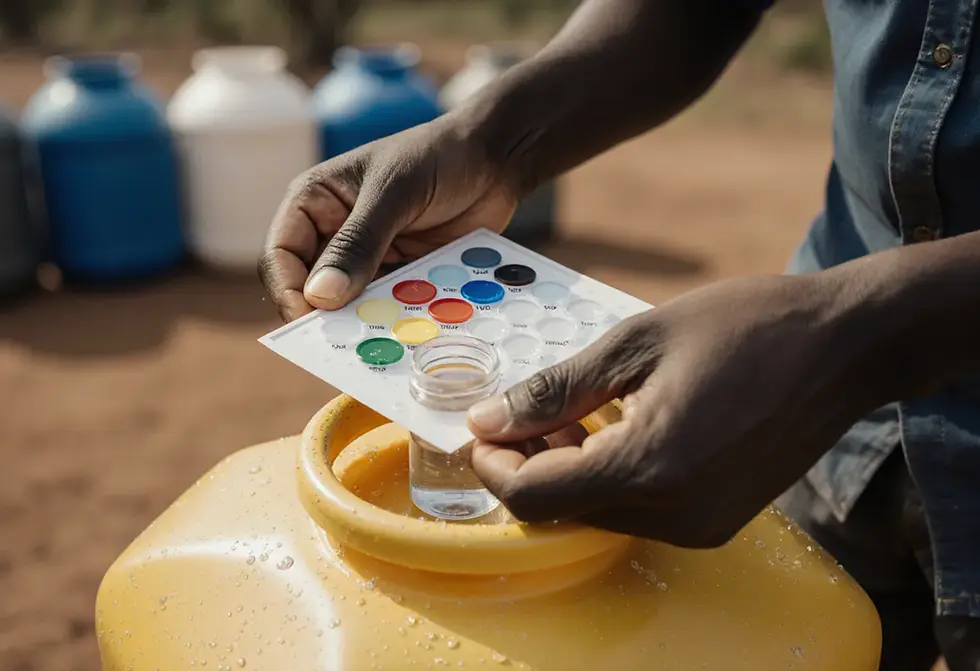
Free residual chlorine is the portion of added chlorine that remains active and available to kill pathogens after the water's immediate chlorine demand has been satisfied. Total chlorine includes chlorine that has already combined with organic matter and ammonia and lost most of its disinfecting power; the free residual is the part still working. When you measure FRC in a jerrycan, you are measuring the protection the water carries forward, not the dose you started with. This is why field teams test the residual rather than trusting the tablet count alone.
What is the Sphere free residual chlorine standard?
Sphere requires a free residual chlorine of at least 0.5 mg/L after 30 minutes of contact time at pH below 8 at the point of treatment, falling to no less than 0.2 mg/L at the point of delivery, with turbidity at or below 5 NTU and zero faecal coliforms per 100 ml. These figures come from the Sphere/IFRC WASH standards (2018). The two numbers matter because chlorine decays as water sits and is handled, so the higher treatment-point figure exists precisely so that enough residual survives the journey to where people drink. SLS supplies the Aquatabs 67mg NaDCC tablets used to hit those targets at scale across South Sudan.
What FRC should I hold 24 hours after treatment?
Hold at least 0.2 mg/L of free chlorine in stored water 24 hours after treatment, which is the CDC household benchmark for safe water at the point of consumption. CDC guidance dosing is roughly 2 mg/L for water below 10 NTU and around 4 mg/L for water above 10 NTU, per the CDC Safe Water System. The 24-hour window is the honest test of a chlorination programme: a residual that looks fine at the tapstand but disappears overnight has failed the household it was meant to protect. Plan your dose for where the water ends up, not where it leaves the system. A wider range of treatment and testing supplies is available through SLS WASH products.
Why does the textbook dose often fail in the field?
The standard dose frequently fails to hold 0.2 mg/L by the time water reaches the household, because heat, high demand, and prolonged storage strip the residual faster than the textbook assumes. In South Sudan refugee camps, between 40% and 58% of households drawing from chlorinated tapstands had no detectable residual chlorine in their stored water; researchers found standard doses could not guarantee 0.2 mg/L FRC 24 hours after distribution and recommended raising the initial target toward 1.0 mg/L, per the Bulletin of the World Health Organization (2015). The practical lesson is to treat the residual as something you defend over a day, not a box you tick at the source. In hot, overcrowded sites, dose toward the upper end of the safe range and test in the home, not only at the point of treatment.
Frequently asked questions
What is the minimum free residual chlorine for safe drinking water in an emergency?
At least 0.2 mg/L at the point of delivery and 0.5 mg/L after 30 minutes of contact at the treatment point, per the Sphere/IFRC WASH standards (2018).
Is 0.2 mg/L or 0.5 mg/L the FRC target?
Both apply at different points: 0.5 mg/L after contact at treatment, and 0.2 mg/L at delivery, under the Sphere/IFRC standards (2018). The higher figure protects against decay in transit and storage.
What FRC should I hold 24 hours after treatment?
A minimum of 0.2 mg/L free chlorine in stored water 24 hours after treatment, the household benchmark set by the CDC Safe Water System.
Why does chlorine drop below standard before water reaches households?
Heat, organic load, and storage time consume the residual; in South Sudan camps, 40-58% of households had no detectable residual in stored water, per the Bulletin of the WHO (2015).
What FRC target should I use during a cholera outbreak?
Dose toward the upper end of the safe range; researchers recommended an initial target toward 1.0 mg/L to ensure 0.2 mg/L survived 24 hours, per the Bulletin of the WHO (2015).
Specialized Logistics Solutions is an in-country distributor based in Juba, an authorised distributor for Aquatabs (Medentech/Kersia), P&G Purifier of Water, and Oxfam tanks (Butyl Products), and a UNGM-registered vendor (No. 380716). In the 2024-2025 South Sudan cholera response, SLS deployed more than 52 million Aquatabs tablets, so the FRC guidance above is grounded in outbreak-scale delivery, not theory. Request a quotation from SLS to size and stock your chlorination programme.
Comments