
The Field Guide to Water Treatment in a Cholera Outbreak: Source to Cup in East and Central Africa

Treat for the cup, not the tank. In a cholera outbreak the only chlorine that matters is the free residual chlorine still present in the jerrycan 24 hours later, and the textbook dose routinely fails to deliver it in a hot, overcrowded camp. During South Sudan's 2024-2025 outbreak, Specialized Logistics Solutions deployed more than 52 million Aquatabs tablets, a treatment capacity exceeding 1 billion litres. This guide sets out what to dose, which product to pick, and how to make the residual hold.
Why does cholera spread through water, and what does treatment have to stop?
Cholera spreads when faecally contaminated water reaches the mouth, so water treatment exists to break that chain at the point of consumption. The bacterium Vibrio cholerae can produce explosive, fast-moving outbreaks, and the World Health Organization estimates 1.3 to 4.0 million cholera cases and 21,000 to 143,000 deaths worldwide each year. The same WHO fact sheet states the obvious operational truth that anchors this whole guide: WASH is essential to prevent cholera.
The scale is not theoretical and it is not historical. In 2023 alone, 535,321 cholera cases and 4,007 deaths were reported across 45 countries. The job of treatment is narrow and unforgiving: deliver water that a displaced family can drink, cook and clean with, and keep it safe through collection, transport and household storage in 35-degree heat. That is a logistics problem as much as a chemistry one, which is why our argument throughout is built around in-country supply and storage that holds, detailed on the WASH products and water treatment page.
There is a second reason treatment carries the load in an outbreak. Cholera kills quickly through dehydration, and a treatment centre can hold the case fatality rate below 1 percent only if the patients arriving have not been re-infected by the same contaminated source on the way home. The WHO benchmark of under 1 percent CFR is a clinical target, but it is reached or missed in the water supply long before a patient reaches a cot. Safe water at the household is the upstream intervention that stops the centre from filling faster than it can empty, which is why a cholera task force that funds only treatment beds and not point-of-use chlorination is fighting the outbreak with one hand.
What is the minimum free residual chlorine target during an outbreak?
The Sphere minimum is free residual chlorine of at least 0.5 mg/L after 30 minutes contact at pH below 8, and at least 0.2 mg/L at the point of delivery, with turbidity at or below 5 NTU and zero faecal coliforms per 100 ml. That standard is published in the Sphere and IFRC WASH standards, and it is the number every WASH officer quotes. The trap is treating it as a tank-side target rather than a household one.
The operative threshold for a cholera response is the household one. The CDC Safe Water System standard calls for a minimum of 0.2 mg/L free chlorine in stored water 24 hours after treatment, with a dose of roughly 2 mg/L for water below 10 NTU and roughly 4 mg/L for water above 10 NTU. Dose to the cup that will be drunk tomorrow morning, not to the tap reading you take at noon. For the underlying chemistry, our explainer on what free residual chlorine is and the target to hit walks through the Sphere number in detail.
Why does the textbook chlorine dose fail before the water reaches the household?
Because chlorine demand in the field is higher than the manufacturer's clean-water test assumes, the standard dose often leaves no measurable residual by the time a family drinks. This is not a hunch. A peer-reviewed study in South Sudanese refugee camps found that 40 to 58 percent of households drawing from chlorinated tapstands had no detectable residual chlorine in their stored water, that standard doses could not ensure 0.2 mg/L FRC 24 hours after distribution, and that researchers recommended raising the initial target toward 1.0 mg/L.
Take that finding seriously and design around it. Heat, sunlight, organic load in the source, dirty collection containers and long carry times all consume chlorine before the first sip. The practical response is to dose to a higher initial target so a residual survives the journey, then verify it at the household rather than at the source. The mechanism, why the curve drops so steeply between tapstand and cup, is the subject of our piece on why chlorine disappears before it reaches the cup.
How do I choose between Aquatabs and P&G Purifier of Water?
Match the product to the water: Aquatabs for clear water, P&G Purifier of Water for turbid or visibly contaminated source water. Aquatabs is the faster, simpler tool where the source is reasonably clear. Its active ingredient is sodium dichloroisocyanurate (NaDCC), a US EPA-registered chlorine donor manufactured by Medentech Ltd of Wexford, Ireland. It is a tablet, a measured dose and a 30-minute wait, which is exactly what a household or a tapstand monitor can manage at scale.
When the source is muddy, chlorine alone is not enough. P&G Purifier of Water, developed with the CDC, treats 10 litres per sachet through coagulation, flocculation and disinfection in around 30 minutes, and it removes Giardia and Cryptosporidium, parasites that resist chlorine on its own. In flood season, when the only available water is brown, the sachet is the right tool. We carry both, with selection logic and stock detailed on the WASH products page, and the head-to-head trade-off is laid out in Aquatabs versus P&G Purifier of Water.
How many Aquatabs do I need, and how do I dose at scale?
For clear water, one Aquatabs 67mg NaDCC tablet treats 8 to 10 litres with a 30-minute contact time; filter cloudy water through a clean cloth first. That instruction comes straight from the CDC and Medentech instruction sheet, and it is the unit you build every larger calculation from. A standard 20-litre jerrycan therefore takes two tablets; the wait, not the tablet count, is what people skip, so make the 30 minutes part of the message.
Scale by working from that per-tablet figure up to the storage vessel and applying the higher field target from the residual study above. Get the dose, the contact time and the per-vessel arithmetic for jerrycans, tanks and tapstands in our Aquatabs dosing guide for litres and vessels. The reason NaDCC suits an outbreak is the form factor: the active ingredient is a US EPA-registered chlorine donor delivered as a stable, pre-measured tablet, so a community health worker dosing hundreds of jerrycans a day makes no measuring error, and the tablets ship and store in heat without the handling hazards of liquid hypochlorite. That is the difference between a protocol on paper and a protocol that survives contact with a crowded water point.
Whichever product you run, the discipline is the same: dose for demand, hold the contact time, and confirm the residual at the household. The most common field failure is not the wrong tablet count; it is collapsing the 30-minute contact time because a queue is forming, or topping up a half-empty jerrycan with untreated water and never re-dosing. Build both into the household message, and pair the tablet with a covered, narrow-necked container so the dose you paid for is not lost to a dirty lid. Stock the authorised, anti-counterfeit tablet from the Aquatabs 67mg product page.
How do I store and protect treated water so the residual survives?
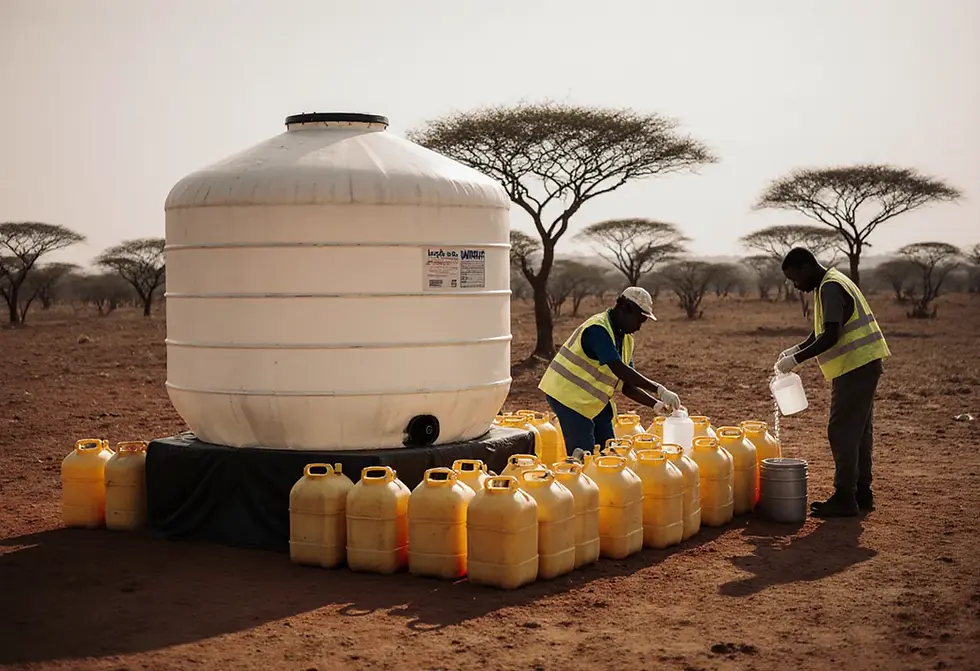
Store treated water in covered, narrow-necked containers and protect the residual all the way to the cup, because uncovered or dirty storage undoes the treatment. Sizing the storage chain correctly, from communal tanks down to household containers, is half the battle in an outbreak, and the wrong tank or a leaking liner reintroduces the contamination you just paid to remove. Our guide to sizing emergency water storage with Oxfam tanks covers the steel-tank capacities and siting logic for camp-scale supply.
At the household level, keep two clean collection containers and verify the chlorine where the water is actually drunk. Field verification is not optional in a cholera response; a tank reading tells you nothing about the jerrycan in a tent three hours later. The step-by-step method for the pool-tester and DPD test is set out in how to read a free residual chlorine field test. Treatment, storage and testing are one chain, and the chain is only as strong as the household end of it.
Why does in-country supply decide whether any of this works?
Because a correct protocol is worthless if the tablets are not in the county when the outbreak peaks. South Sudan's outbreak, declared on 28 October 2024, reached nearly 100,000 suspected cases and more than 1,500 deaths across 55 counties. In the first phase of 2025 the same outbreak drove a high case fatality rate: from 1 January to 17 August 2025, South Sudan reported 71,825 suspected cholera cases and 1,194 deaths, a CFR of 1.7 percent, well above the under-1 percent that WHO sets as the benchmark for adequate case management.
Supply that arrives late is supply that does not count. The outbreak began in Renk among returnees from Sudan, and the sustained response brought weekly cases down from around 1,000 at the December 2024 peak to 114 in the week ending 28 September 2025, with 8.6 million oral cholera vaccine doses administered. Treatment products had to move alongside that vaccination campaign, into the same hard-to-reach counties, on the same compressed timelines.
This is the practical case for buying in-country rather than ex-works from a distant port. An order placed on a manufacturer's overseas price list still has to clear customs, survive the road, and reach Renk or a Jonglei IDP site before the curve moves; an outbreak does not wait for a 10-week ocean freight lead time. Holding authorised stock in a Juba warehouse collapses that lead time to a last-mile dispatch, and it removes the counterfeit and warranty risk that comes with grey-market chlorine bought under outbreak pressure. The chemistry in this guide is the easy part; getting the right product, in the right form, to the right county before the residual matters is the part that decides outcomes. That is the work our South Sudan country page and our UN agency and NGO sector page are built around.
What did SLS actually deliver, and what does it prove?
We supplied two distinct treatment products at outbreak scale, dated and on record. Against the clear-water need, SLS deployed 5,207 boxes and more than 52 million Aquatabs tablets in the 2024-2025 response, a treatment capacity exceeding 1 billion litres. That is treatment capacity, tablets multiplied by rated litres per tablet, not litres measured at the cup, and we state it that way on purpose; the credibility of the number depends on not stretching it.
Against the turbid-water need, we ran the P&G chain. SLS distributed 3.28 million P&G Purifier of Water sachets, reaching 27,344 households across Juba and Renk, at 120 sachets per household, working with Butyl Products UK, CMMB and ACHO through procurement, customs clearance, Juba warehousing and last-mile delivery. "Reached 27,344 households" means distributed to, not verified consumption, and the per-household figure is a design capacity, not a measured one. Two products, two water types, one in-country chain. That is the proof behind the WASH products page.
Related WASH field guides
This cornerstone is the map; the detailed mechanics live in the spokes. Read on for the specific number you need:
Frequently asked questions
What free residual chlorine level is safe for drinking water in a cholera outbreak?
Aim for at least 0.5 mg/L after 30 minutes contact at pH below 8 and at least 0.2 mg/L at the point of delivery, the Sphere WASH minimum. For household storage, hold at least 0.2 mg/L free chlorine 24 hours after treatment, per the CDC Safe Water System.
How many Aquatabs tablets do I need per jerrycan?
One Aquatabs 67mg NaDCC tablet treats 8 to 10 litres of clear water with a 30-minute contact time, so a 20-litre jerrycan takes two tablets; filter cloudy water through a clean cloth first, per the CDC and Medentech instruction sheet.
When should I use P&G Purifier of Water instead of Aquatabs?
Use P&G when the source water is turbid or visibly contaminated. P&G Purifier of Water treats 10 litres per sachet through coagulation, flocculation and disinfection, and removes Giardia and Cryptosporidium that resist chlorine alone; Aquatabs is the right tool for clear water.
Why does treated water still test negative for chlorine at the household?
Because field chlorine demand exceeds the clean-water test dose. A study in South Sudanese refugee camps found 40 to 58 percent of households had no detectable residual chlorine in stored water and recommended raising the initial target toward 1.0 mg/L so a residual survives to the cup.
How dangerous is the current cholera situation in South Sudan?
It is severe and recent. The outbreak declared on 28 October 2024 reached nearly 100,000 suspected cases and more than 1,500 deaths across 55 counties, with a case fatality rate of 1.7 percent in the first eight months of 2025.
Talk to a supplier who has done this at outbreak scale
Specialized Logistics Solutions is in Juba, not at a distant port, and we are an authorised distributor for Aquatabs (Medentech/Kersia), P&G Purifier of Water, and Oxfam tanks (Butyl Products), registered on the UN Global Marketplace as vendor 380716. In the 2024-2025 cholera response we moved 52 million-plus Aquatabs tablets and 3.28 million P&G sachets through procurement, customs, Juba warehousing and last-mile delivery, the part of WASH that decides whether a correct dose ever reaches a household. Request a quotation and tell us your water type, your county and your timeline.
Comments