
Preparing for South Sudan's 2026 Rainy Season: Flood Pumps & Water Purification Guide
- Tony Miller
- Mar 16
- 7 min read

Every year, South Sudan's rainy season arrives with a familiar and devastating pattern. Roads that were passable in March become impassable rivers of mud by May. IDP camps constructed on elevated ground find themselves surrounded by standing water. Boreholes are overwhelmed by runoff. Latrines overflow. And within weeks, cholera and acute watery diarrhoea (AWD) spread through communities that have no access to safe drinking water. The 2026 rainy season — forecast to be another heavy one — demands early, decisive action from every NGO, UN agency, and government body operating in South Sudan.
The window to pre-position critical flood response equipment is narrow. Once the rains arrive in April, road access into Unity State, Jonglei, and Greater Upper Nile deteriorates rapidly. Procurement decisions made today determine whether your teams have Multiquip dewatering pumps, Aussie submersible pumps, stockpiles of Aquatabs water purification tablets, and P&G Purifier of Water sachets on the ground when they are needed — or whether they are waiting weeks for delivery after the crisis has already deepened.
⚠ WHY 2026 DEMANDS EARLY ACTION
South Sudan has experienced catastrophic flooding every year since 2019, with over 1.4 million people affected in 2024 alone across 44 counties. The 2025–26 La Niña weather pattern brings above-average rainfall forecasts for East Africa. Flood-prone areas in Jonglei and Unity States are already saturated from previous seasons. Pre-positioning is not optional — it is the difference between effective response and reactive crisis management.
Understanding South Sudan's Flood Season
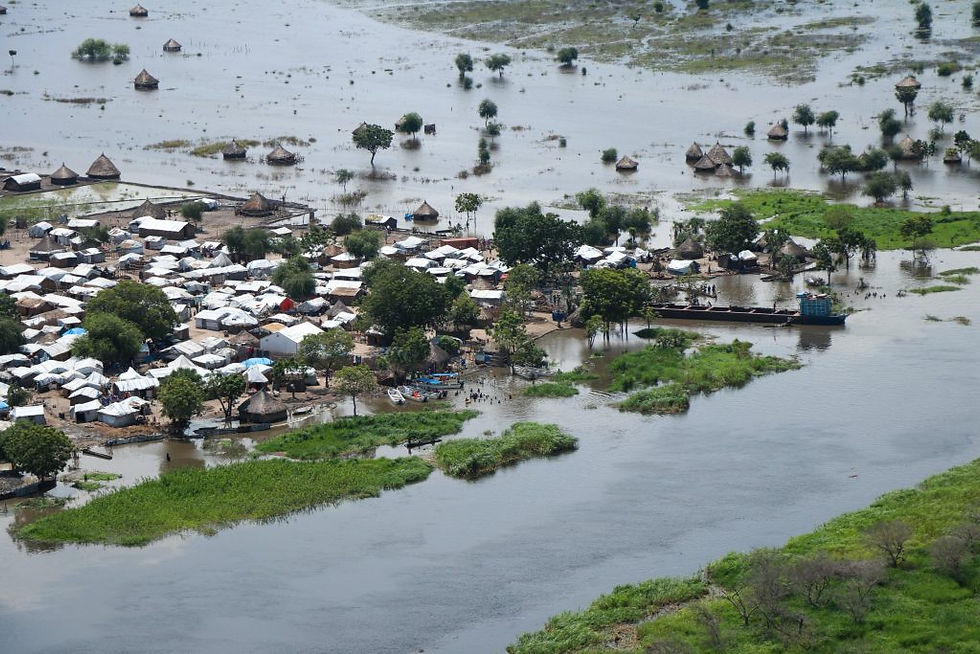
South Sudan's rainy season runs from April through October, with peak flooding typically occurring between August and November as waters accumulate in the White Nile basin and the vast Sudd wetlands of central South Sudan. The country sits within one of the world's largest freshwater swamp systems, and as upstream rainfall surges, low-lying counties have nowhere to drain.
What makes South Sudan's flooding uniquely complex is that it occurs on top of an existing multi-layered humanitarian crisis. Conflict-related displacement, food insecurity, and severely limited healthcare infrastructure mean that flood-contaminated water sources trigger cholera outbreaks almost immediately. The 2024–25 cholera emergency — which reached over 13,200 cases and 199 deaths within weeks of onset — was directly linked to flooding-contaminated water sources across Upper Nile State and Jonglei.
The most consistently affected areas are Unity State (Bentiu, Rubkona), Jonglei State (Bor, Old Fangak, Twic East), Upper Nile State (Malakal, Renk), and the Greater Pibor Administrative Area. These locations require the earliest pre-positioning of dewatering equipment and water treatment supplies — and they are precisely where road access becomes most compromised once rains begin.
ℹ KEY FLOOD-RISK COUNTIES IN 2026
Unity State · Jonglei State · Upper Nile State · Greater Pibor Administrative Area · The Sudd wetlands corridor. According to OCHA's 2025 Humanitarian Needs and Response Plan, these areas face a combination of flooding, displacement, and disease risk that requires pre-emptive WASH cluster mobilisation.
Flood Response Pumps: Multiquip & Aussie Pumps in South Sudan
When floodwaters rise, the immediate operational challenge is water removal. Dewatering pumps are the first line of defence for protecting IDP camp infrastructure, health facilities, food storage, and community latrines from inundation. In South Sudan's demanding environment — remote access routes, inconsistent fuel supply, extreme heat, and debris-laden floodwater — pump selection and pre-positioning are critical decisions.
Specialized Logistics Solutions (SLS) is the authorised in-country distributor for both Multiquip and Aussie Pumps across East and Central Africa, maintaining inventory in Juba for rapid deployment. Both brands are trusted by international humanitarian organisations precisely because they perform reliably under the conditions found in South Sudan.
Multiquip Pumps: Proven in the Field
Multiquip pumps have earned a reputation as the workhorses of humanitarian flood response. Available in diesel and petrol configurations, Multiquip's dewatering and trash pump range is designed for extended deployment in challenging conditions. Their self-priming centrifugal models allow rapid mobilisation without the need for pre-filled suction lines — a critical advantage when teams are deploying to newly flooded areas. Trash pump models handle the debris-laden, contaminated floodwater that overwhelms standard dewatering units, making them essential for latrine surrounds, damaged borehole areas, and agricultural flood zones. Multiquip parts are widely serviceable in East Africa, reducing downtime risk during extended deployments.
Aussie Pumps: Australian Engineering for Extreme Conditions
Aussie Pumps brings Australian-engineered reliability to the full spectrum of flood response requirements. Their submersible pump range is ideal for scenarios where pumps must operate fully submerged — IDP camp drainage trenches, flooded health post basements, and water recovery from deep-inundated areas. Lightweight high-flow models can be transported by boat or air to cut-off locations during peak flooding. Aussie Pumps also offers ultra-high-flow centrifugal units for large-scale dewatering operations such as the dyke and berm reinforcement work conducted annually along the Jonglei canal corridor.
Selecting the Right Pump for Your Operation
The right pump depends on the scenario. For relatively clear standing water in IDP camps and facilities: submersible dewatering pumps (Aussie). For debris-heavy, sewage-contaminated floodwater: trash pumps (Multiquip or Aussie). For large-volume dyke and berm operations: high-flow self-priming centrifugal pumps (Multiquip). SLS recommends organisations pre-position a mixed pump package at key hubs — Juba, Bentiu, Malakal, and Bor — before April. Once roads become impassable, procurement lead times extend to 4–6 weeks minimum, with air freight as the only alternative at significantly greater cost.
✅ SLS PUMP DEPLOYMENT SUPPORT
SLS provides end-to-end pump sourcing, in-country logistics to secondary hubs, operator training, and maintenance support for Multiquip and Aussie Pumps across South Sudan. Contact us at sales@maji-safi.org or visit specializedlogistics.org/pumpequipment for the full range.
Water Purification: Aquatabs & P&G Purifier of Water
Dewatering pumps remove floodwater. But from the moment communities begin using surface sources — contaminated rivers, inundated boreholes, makeshift collection points — the risk of waterborne disease escalates rapidly. During flooding in South Sudan, cholera, typhoid, and AWD are not hypothetical. They are documented, recurring consequences of contaminated water access. The two water purification solutions most widely deployed — and officially recommended — in South Sudan's humanitarian WASH programmes are Aquatabs and P&G Purifier of Water, both available through SLS in Juba.
Aquatabs: The World Standard for Household Water Treatment
Aquatabs, using NaDCC (sodium dichloroisocyanurate) technology, are the most widely used water purification tablet in humanitarian response globally. Endorsed by WHO, UNICEF, and USAID, a single tablet purifies a standard 20-litre jerrycan in 30 minutes, killing 99.9999% of bacteria including Vibrio cholerae and achieving 99.99% reduction in viruses and parasites. Aquatabs continue protecting treated water against recontamination for up to 24 hours — critical in camp settings where treated water is stored before use.
Aquatabs come in strip-pack formats with a five-year shelf life, making them ideal for pre-season stockpiling. They are iodine-free, leave no unpleasant aftertaste, and have been validated in South Sudan cholera response operations. In the 2024–25 cholera emergency, over two million Aquatabs were distributed to treat millions of gallons of water across the most affected communities. SLS stocks Aquatabs in Juba with formats available for 10L and 20L containers as well as larger tank treatment doses.
P&G Purifier of Water: For Turbid Floodwater
P&G Purifier of Water sachets fill a critical gap that tablet-based solutions alone cannot address: highly turbid, sediment-heavy floodwater. Each sachet combines a coagulant-flocculant with a disinfectant in a two-step process — first clearing mud, sediment, and physical contaminants through flocculation, then disinfecting to kill pathogens. The result is water that is both visually clear and microbiologically safe. One sachet treats 10 litres of even heavily contaminated floodwater.
Endorsed by WHO and USAID, P&G Purifier of Water is the recommended solution when floodwater is visibly turbid — a common condition in South Sudan during peak flooding when river and borehole water is laden with agricultural runoff and sewage. SLS has documented the product's performance in cholera response operations in Juba — read the full case study at specializedlogistics.org/cholera-case-study-juba.
Using Aquatabs and P&G Together: A Comprehensive Strategy
For thorough flood season preparedness, SLS recommends stocking both products. Aquatabs are the standard household-level distribution tool across affected communities — fast, scalable, and straightforward for hygiene promotion networks to deploy. P&G sachets are reserved for field teams and locations where turbid floodwater is the primary available source. Together, they cover the full spectrum of water quality risks encountered during South Sudan's rainy season, from the clear-but-contaminated water of functioning boreholes to the heavily turbid overflow of flooded rivers.
⚠ CRITICAL FIELD NOTE ON BOREHOLE SAFETY
Even previously safe boreholes can become contaminated during flooding if the borehole surround is inundated by floodwater. During flood conditions, ALL water sources should be treated — not just surface water. Treat borehole water with Aquatabs and conduct sanitary surveys and rehabilitation as soon as floodwaters recede.
Pre-Season Procurement Timeline: Act Before the Rains
Effective flood preparedness is about timing. The table below outlines the recommended procurement and logistics calendar for organisations operating in flood-risk areas of South Sudan.
January – February 2026 Conduct needs assessment. Review pump inventory and WASH stock gaps. Issue RFQs to SLS for Multiquip, Aussie Pumps, Aquatabs, and P&G. Confirm procurement budgets and authorisations.
February – March 2026 Confirm purchase orders. Arrange customs documentation for equipment imports. Coordinate delivery to Juba warehouse or secondary hubs (Bentiu, Malakal, Bor). Pre-stock minimum 3-month supply of water purification tablets.
March – April 2026 Receive and inspect equipment. Conduct pump operator training with SLS technical support. Pre-position assets at strategic field locations before roads deteriorate.
April – May 2026 (Rains Begin) Activate pump deployment teams. Begin Aquatabs distribution through hygiene promotion networks. Monitor cholera and AWD incidence via WASH Cluster coordination.
August – November 2026 (Peak Flooding) Deploy P&G sachets in highest-turbidity flood zones. Coordinate emergency resupply via air freight where roads are cut. Begin borehole assessments as waters recede.
Why Source Through Specialized Logistics Solutions?
Specialized Logistics Solutions has operated in South Sudan and the wider East Africa region for over 35 years. We are the authorised in-country distributor for Multiquip, Aussie Pumps, Aquatabs, and P&G Purifier of Water — which means no third-party mark-ups, shorter lead times, and direct technical support from the brands whose equipment your teams are deploying. Our Juba warehouse at Unit 5, Da Vinci Lodge holds standing inventory across all product lines, enabling emergency order fulfilment without the delays inherent to international procurement.
We have delivered thousands of units of WASH products and large pump packages for IOM, UNMISS, WHO, and leading international NGOs operating across South Sudan. Our logistics capacity scales to meet urgent, high-volume demands — and we deliver to secondary hubs and, where necessary, by boat and air freight to locations cut off by peak flooding.
Comments