
Modular Warehousing vs. Permanent Structures: Which is the Right Strategic Asset for Your South Sudan Operations?

Why Storage Infrastructure Defines Mission Success in South Sudan
When organisations plan operations in South Sudan — whether humanitarian relief, commercial logistics, NGO field programmes, or government supply chains — they face one of the most unforgiving operating environments on the planet. Seasonal flooding across the Nile Basin, extreme heat, compromised road networks, unpredictable security conditions, and complex customs landscapes combine to make every logistical decision consequential. Among the most strategically important of those decisions is often the most overlooked: where and how you store your goods.
The choice between modular warehousing and permanent structures in South Sudan is not simply a question of budget or architecture. It is a strategic asset decision — one that affects your supply chain resilience, operational agility, total cost of ownership, and ultimately, the effectiveness of your mission. With organisations like UNMISS, IOM, WHO, and a growing number of commercial entities operating across Juba, Malakal, Wau, and Bentiu, the demand for fit-for-purpose warehousing solutions has never been higher.
At Specialized Logistics Solutions (SLS), headquartered in Juba, South Sudan, we have spent over 35 years working alongside international organisations, UN agencies, NGOs, and private sector clients navigating exactly these decisions. In partnership with Hallgruppen — a globally recognised leader in modular warehouse engineering — SLS offers the full spectrum of warehousing solutions: from rapidly deployable temporary structures to robust semi-permanent and permanent installations. This article provides a comprehensive, keyword-optimised analysis of both options to help your organisation make the most informed strategic choice.
Key Takeaway: In South Sudan's complex operating environment, the right warehousing solution is rarely a one-size-fits-all decision. Understanding the trade-offs between modular and permanent structures is essential to building a resilient, cost-effective supply chain.
Understanding the South Sudan Warehousing Landscape
South Sudan's infrastructure challenges are well-documented. According to the World Bank, the country ranks among the least developed in terms of road density, built environment, and formal construction capacity. The capital, Juba, functions as the primary logistics hub, but connectivity to secondary cities like Renk, Torit, and Rumbek remains seasonal and heavily weather-dependent. This reality shapes every warehousing decision in the country.
The annual rainy season — typically running from April through November — renders many roads impassable and can flood ground-level storage facilities without adequate preparation. The dry-season heat, which regularly surpasses 40°C, places enormous stress on standard building materials and creates temperature-sensitive storage challenges for medical supplies, food commodities, and chemicals.
Additionally, land tenure in South Sudan presents a significant legal and logistical challenge. Permanent land ownership for foreign organisations is complex and subject to government approval processes that can take years. For many humanitarian and commercial operators, this alone makes permanent construction a distant second choice to modular deployments that can be commissioned, operated, and relocated without the same regulatory burden.
What is Modular Warehousing?
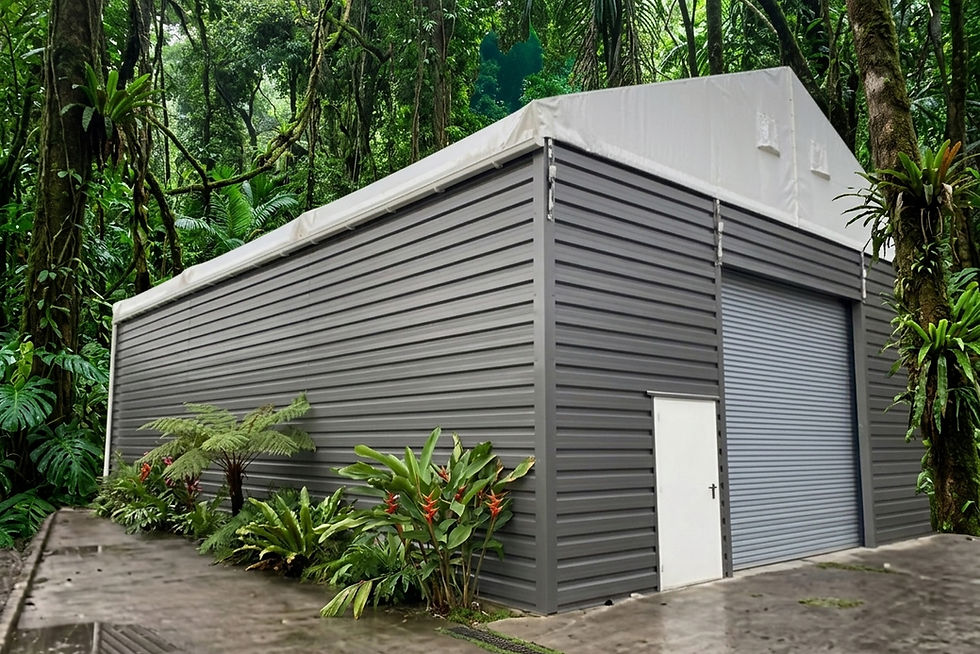
Modular warehousing refers to pre-engineered, factory-fabricated storage structures that are transported to site and assembled rapidly — often within days or weeks — without the need for extensive foundations, skilled construction labour, or lengthy permitting processes. Hallgruppen's modular warehouse systems, supplied by SLS across East and Central Africa, exemplify this category: engineered in Europe, tested for extreme climates, and designed for assembly by trained field teams with minimal specialist equipment.
These structures range from compact 100m² temporary facilities designed for emergency response operations, to large-scale semi-permanent and permanent modular buildings exceeding 2,000m² that can serve as long-term logistics hubs, aid distribution centres, and industrial storage facilities. The key distinguishing feature is scalability and portability: modular systems can be expanded, downsized, relocated, or reconfigured as operational needs evolve — a defining advantage in South Sudan's dynamic environment.
What are Permanent Warehousing Structures?
Permanent warehouse structures are conventionally constructed buildings — typically concrete block, steel frame, or reinforced concrete — built on permanent foundations with the intention of serving a fixed location for decades. In more stable markets, permanent warehouses represent sound capital investment. In South Sudan, however, the calculus is fundamentally different. Construction costs are inflated by the need to import most materials, skilled labour is scarce, timelines are subject to significant delays, and the structures, once built, cannot be redeployed if the operational mandate changes or security conditions deteriorate.
That said, permanent structures do offer advantages that modular systems cannot fully replicate: deeper integration with utilities, greater structural mass for securing high-value or high-risk goods, and the potential for customised internal layouts that can be built into the architecture from the outset.
Modular vs. Permanent Warehousing: A Strategic Comparison
The table below summarises the key strategic dimensions across which modular and permanent warehousing options differ in the South Sudan context:
Factor | Modular Warehousing | Permanent Structures |
Deployment Speed | Days to weeks | Months to years |
Upfront Cost | Lower (leasing options available) | Higher capital expenditure |
Flexibility | Fully relocatable & scalable | Fixed, difficult to modify |
Climate Resilience | Engineered for extreme heat/rain | Depends on construction quality |
Regulatory Risk | Minimal — temporary use exemptions | Subject to full planning approval |
Long-term ROI | Excellent for 1–5 year mandates | Better for 10+ year commitments |
Five Key Factors to Evaluate for South Sudan Operations
1. Deployment Speed and Operational Urgency
In humanitarian logistics and emergency response contexts, time is often the most critical variable. When a cholera outbreak strikes, when floods displace communities, or when a new field programme is activated, the ability to stand up a storage facility within days — rather than months — can determine whether an intervention succeeds or fails. Modular warehousing in South Sudan offers a decisive advantage on this dimension.
Hallgruppen's temporary and semi-permanent warehouse systems, supplied through SLS, can be assembled by a small specialist team in as little as three to five days for standard configurations. This rapid deployment capability has been demonstrated across numerous humanitarian response scenarios in South Sudan, including flood relief operations in Jonglei State and supply chain support for UNMISS field missions. Permanent structures, by contrast, typically require a minimum of six to eighteen months from design through construction completion — a timeline that disqualifies them from emergency and short-to-medium term programme support.
SLS Advantage: Through our partnership with Hallgruppen and our pre-positioned inventory capacity, SLS can mobilise modular warehouse structures to any accessible location in South Sudan within days of order confirmation.
2. Total Cost of Ownership (TCO) and Budget Constraints
For NGOs and humanitarian organisations operating under donor-funded programme budgets, capital expenditure on permanent construction is often explicitly prohibited. Most grant agreements treat construction as a long-term asset that creates accountability complexities around asset transfer, depreciation, and programme closure. Modular warehousing, particularly when procured through leasing or rental arrangements, aligns far more naturally with humanitarian financing models.
However, total cost of ownership analysis over extended timeframes (ten years or more) reveals a more nuanced picture. Permanent structures, despite their higher upfront cost, can offer lower cost-per-square-metre-year over the long term if the organisation has a stable, enduring presence in a fixed location. The critical variable is the certainty of the operational mandate. If there is any realistic scenario in which the warehouse will need to be relocated or the programme wound down within five years, modular warehousing almost always delivers superior TCO because the structure retains residual value through relocation and redeployment rather than being stranded.
3. Climate Resilience and Environmental Performance
South Sudan's climate poses exceptional challenges to storage infrastructure. The combination of intense heat, heavy seasonal rainfall, high humidity, and — in some regions — annual flooding creates conditions that degrade standard construction materials rapidly. Conventional concrete block construction, if not properly designed for the local climate, is susceptible to cracking, damp penetration, and structural deterioration.
Modern engineered modular warehouses from Hallgruppen are specifically designed to perform in extreme climates. The steel framing systems used in Hallgruppen's warehouse range are galvanised and coated for corrosion resistance, while the cladding panels provide superior thermal performance compared to single-skin concrete construction. Advanced ventilation systems can be integrated to manage internal temperatures, protecting temperature-sensitive commodities without the energy costs associated with full air conditioning. For organisations storing medical supplies, nutritional products, or chemical inputs in South Sudan, this climate engineering represents a significant operational advantage.
4. Regulatory Compliance and Land Tenure
One of the most underappreciated advantages of modular warehousing in South Sudan relates to regulatory risk management. Obtaining planning permission for permanent construction in South Sudan involves navigation of both national and local government approval processes that can be lengthy, uncertain, and subject to political interference. Land tenure disputes — a pervasive challenge across the country, particularly in areas outside Juba — add further legal risk to permanent construction investment.
Modular structures, particularly those classified as temporary or semi-permanent, typically attract a simpler regulatory footprint. They can often be deployed under humanitarian operational permits or short-term land-use agreements without triggering the full planning approval process required for permanent buildings. This not only accelerates deployment but significantly reduces the legal and political risk exposure associated with the investment. For organisations planning to operate for a defined programme period — say, three to seven years — this regulatory flexibility can be decisive.
5. Scalability, Reconfigurability, and Future-Proofing
South Sudan's operational environment is inherently dynamic. Programme mandates expand and contract, funding cycles shift, security conditions change, and new operational priorities emerge. The warehouse infrastructure that was right for a programme's initial phase may be poorly matched to its needs two years later. This is where modular warehousing delivers perhaps its most distinctive strategic value: the ability to scale up, scale down, reconfigure, or relocate the facility without the capital write-off associated with abandoning permanent construction.
Hallgruppen's modular systems are designed for exactly this kind of operational flexibility. Additional bays can be added to an existing structure to expand capacity. Internal configurations can be modified to accommodate different racking systems, cold storage modules, or vehicle maintenance workshops. And when a programme concludes, the structure can be dismantled, transported, and redeployed to a new location — preserving asset value rather than leaving a stranded investment.
When Permanent Structures Make Strategic Sense in South Sudan
While modular warehousing offers compelling advantages across most South Sudan operational scenarios, there are specific situations where investment in permanent structures is strategically justified — and potentially superior.
Organisations with a long-term, legally secured presence in a stable urban location — such as established INGOs with thirty-plus year South Sudan mandates operating from a titled property in Juba — may find that permanent construction delivers better long-term value once the initial capital hurdle is cleared. Similarly, government-linked institutions investing in national infrastructure development may have both the mandate and the capacity to undertake permanent construction as part of a broader infrastructure development programme.
Specialised storage requirements — such as secure vaults for high-value items, chill rooms for pharmaceutical cold chain, or vehicle maintenance workshops requiring deep foundations — may also argue for permanent or hybrid construction approaches. In these cases, SLS can support organisations in assessing whether a hybrid solution — permanent core infrastructure complemented by modular expansion units — represents the optimal approach.
Hybrid Approach: Many of SLS's most sophisticated clients are now adopting hybrid warehousing models — permanent anchor facilities complemented by modular expansion units — to capture the benefits of both approaches while managing their respective limitations.
SLS Modular Warehousing Solutions: What We Offer
Specialized Logistics Solutions, in partnership with Hallgruppen, offers a comprehensive portfolio of modular warehousing and storage solutions for South Sudan operations. Our warehouse product range spans four core categories:
Temporary Warehouses — rapidly deployable lightweight structures for emergency response and short-term programme support. Assembly time: 2–7 days. Ideal for humanitarian surge operations, field office support, and disaster response logistics.
Semi-Permanent Structures — engineered for medium-term operations (1–7 years), offering enhanced durability, expanded configuration options, and improved thermal performance. Suitable for programme logistics hubs, distribution centres, and field base support.
Permanent Modular Warehouses — Hallgruppen's highest-specification modular buildings, designed for long-term (10+ year) operations. These structures combine the speed and flexibility of modular construction with the durability and performance of permanent infrastructure.
Custom-Built Storage Solutions — bespoke warehousing designed in collaboration with Hallgruppen engineers to meet specific operational requirements, including refrigerated units, secure storage, vehicle maintenance workshops, and multi-function field bases.
Every SLS warehousing solution comes with expert installation support from our on-ground team, rapid sourcing and procurement through our pre-positioned inventory, and ongoing technical support throughout the asset lifecycle.
Conclusion: Modular Warehousing as the Strategic Default for South Sudan
For the vast majority of organisations operating in South Sudan — whether humanitarian agencies, development organisations, commercial logistics providers, or government-linked supply chain operators — modular warehousing represents the strategically superior choice. It offers faster deployment, lower regulatory risk, superior operational flexibility, climate-engineered performance, and better alignment with the financing and mandate structures of organisations working in complex environments.
Permanent structures retain strategic relevance for a specific subset of long-term, capital-funded, land-secure operations — and SLS can support organisations in evaluating and delivering these solutions when they are the right fit. But for the dynamic, time-sensitive, and resource-constrained reality of most South Sudan operations, modular warehousing is not just a practical solution — it is a strategic asset.
Specialized Logistics Solutions is uniquely positioned to support your warehousing decision in South Sudan. With 35 years of on-the-ground operational experience in East and Central Africa, a proven partnership with Hallgruppen, and a track record of delivering modular warehouse solutions to some of the world's most demanding environments, SLS is your trusted partner for infrastructure that works — exactly where and when you need it.
Comments