
Modular vs Permanent Warehousing in South Sudan

Choose modular when the operation is measured in months, the site may move, and the stock arrives before the building can. A standard humanitarian Mobile Storage Unit gives you 240 square metres of covered floor and around 840 cubic metres of capacity that can be erected in days, while a permanent steel-and-concrete warehouse takes months to build and only earns its cost over a multi-year footprint. In South Sudan, where roads and seasons decide everything, that timeline is usually the deciding factor.
What is the real difference between modular and permanent warehousing?
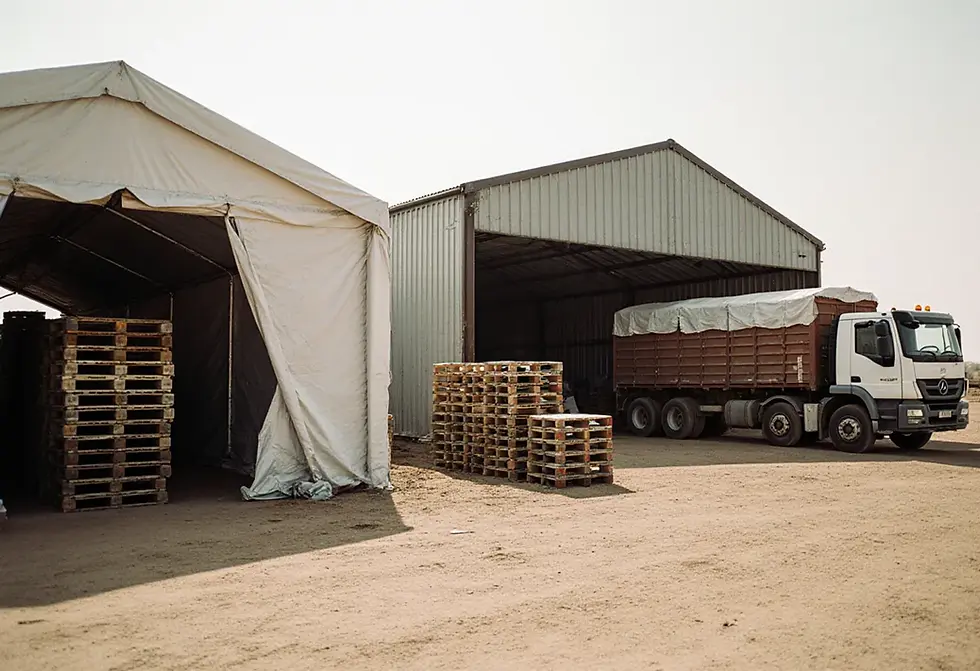
The difference is not the wall material; it is how fast the structure stands up, whether it can move, and how long it is meant to last. A modular Mobile Storage Unit (MSU) is a rapid-deploy tensioned structure: the standard humanitarian MSU measures 24 by 10 by 5 metres, giving 240 square metres of floor and roughly 840 cubic metres of capacity, and it is the unit WFP and the Logistics Cluster procure and donate for sudden-onset response. It ships flat, travels on a normal truck bed, and a trained crew raises it in days on prepared ground.
A permanent warehouse is the opposite trade. It is a steel-frame or block building on a poured foundation, designed for a decade or more of service, with better security, insulation and load-bearing racking. It also needs land tenure, a foundation, skilled trades, imported materials, and a construction window that the rainy season will interrupt. The honest summary is that modular buys you speed and mobility, permanent buys you durability and lower cost per stored tonne over many years, and the right answer depends entirely on how long you will hold the site.
Why does speed decide the choice in South Sudan?
Because in South Sudan the building has to beat the rains, and stock routinely arrives before any permanent structure could exist. South Sudan has roughly 20,000 kilometres of road of which only 400 kilometres are paved, and most rural roads become impassable in the rainy season. That single fact reshapes warehouse planning: if you cannot reach a county for months, you must preposition stock there before the roads close, and you need somewhere to put it now, not after a construction contract runs its course.
This is where modular wins outright. A pre-positioning operation that depends on a permanent build will miss the season; a modular unit trucked in and raised in days lets you store relief cargo at the point of need before access is lost. The wider response is leaner than it has ever been: 2025 was the worst humanitarian funding year on record, with funding back at 2016 levels and around 25 million fewer people reached than in 2024, and in South Sudan that pressure has already forced WFP into 50 to 70 per cent rations against a US$398.9 million six-month shortfall. Capital tied up in a permanent build is capital not buying commodities, which pushes most short-to-medium operations toward modular storage they can redeploy when the response moves.
How fast can each option be standing and storing stock?
Modular MSU: days, not months. Once the ground is prepared and the unit is on site, a trained crew assembles the frame and cladding and you are storing stock the same week. The bottleneck is rarely the structure; it is the last-mile delivery to the county.
Permanent warehouse: months. Land agreement, ground survey, foundation, frame, cladding, doors and security all sit in series, and any phase that lands in the wet season stalls. Budget a build window measured in seasons, not weeks.
The speed of the wider supply chain shows what "fast" should mean. WFP's pre-positioning hubs are built so that relief items can be dispatched within 48 hours of a partner request. A warehouse that cannot stand up inside that kind of operational tempo is the wrong tool for an active emergency, which is exactly why MSUs, not permanent depots, are the default first structure on a new response.
What about cost: when does permanent actually pay off?
Permanent wins on cost per stored tonne only when the operation is genuinely long-term and the site is fixed. A permanent warehouse carries a high up-front capital cost and the durability to amortise it over ten years or more; spread across a multi-year, single-location programme, its cost per stored tonne falls below renting or buying modular units repeatedly. Modular reverses the maths: lower up-front outlay, faster to revenue in storage terms, and the unit redeploys to the next site instead of being abandoned when the response ends.
The deciding question is duration and certainty, not headline price. For a one-to-three-year response, or any site that might move, modular is almost always the lower true cost once you account for the risk of stranding a permanent asset in a location the operation has left. For a fixed national or hub warehouse you will run for a decade, permanent is the cheaper steady state. A common middle path is a semi-permanent insulated structure that lasts years, deploys far faster than a block build, and can still be relocated, which suits the many South Sudan operations that are neither truly short-term nor truly permanent. SLS sizes and supplies modular, semi-permanent and permanent warehouses against the actual duration of the operation rather than selling a single format.
How does siting and the rainy season change the answer?
Siting is where good warehouse decisions are won or lost in South Sudan, and it favours structures you can place, raise and move with the season. Modular units let you site storage close to the population before access closes, then strike and redeploy when the operation shifts; a permanent building commits you to one plot regardless of how the displacement map changes. Given that most rural roads are inaccessible during the rains, the ability to preposition at a forward location and relocate later is an operational advantage, not a luxury.
Whatever the format, the same site fundamentals apply: raised, well-drained ground above the flood line, compacted hardstanding for the floor, drainage cut around the structure, and a turning area a truck can actually use in mud. A permanent warehouse on a poor site is a worse outcome than a modular unit on a good one. This is the layer a generalist structure vendor does not cover, because the structure is only as useful as the ground it sits on and the road that reaches it.
Which should you choose?
Default to modular for anything short-to-medium term, mobile, or racing the rains, and reserve permanent for a fixed, long-horizon hub you will run for years. Most South Sudan field operations fall into the first category, which is why the rapid-deploy MSU is the workhorse of humanitarian storage and the permanent warehouse is the exception reserved for established national logistics hubs. The strongest answer is rarely "modular or permanent" in the abstract; it is matching the structure to the duration, the access window, and the chance the site will move, then getting it standing before the season decides for you.
Frequently asked questions
How big is a standard humanitarian mobile storage unit?
A standard humanitarian Mobile Storage Unit measures 24 by 10 by 5 metres, giving 240 square metres of floor and roughly 840 cubic metres of capacity, per the Logistics Cluster.
How long does a modular warehouse take to deploy versus a permanent build?
A modular MSU can be erected in days once the ground is prepared and the unit is on site, while a permanent steel-and-concrete warehouse takes months and stalls whenever construction lands in the rainy season.
When is a permanent warehouse the cheaper option?
Only for a fixed site run over many years, where the high up-front cost is amortised across a decade or more; for short-to-medium or relocatable operations, modular storage is usually the lower true cost because the unit can be redeployed instead of stranded.
Why does modular storage suit South Sudan specifically?
Because only 400 kilometres of South Sudan's roughly 20,000 kilometres of road are paved and most rural roads close in the rains, so stock must be prepositioned at forward sites before access is lost, and only a structure that stands up in days can keep pace.
What site conditions does a warehouse need regardless of type?
Raised, well-drained ground above the flood line, compacted hardstanding for the floor, drainage around the structure, and a usable truck turning area in mud; a structure on a poor site performs worse than a modular unit on a good one.
Specialized Logistics Solutions is an in-country distributor based in Juba, an authorised distributor for Aquatabs (Medentech/Kersia), P&G Purifier of Water, Oxfam tanks and Butyl, Multiquip and Aussie Pumps, and Hallgruppen modular and permanent structures, and a UNGM-registered vendor (No. 380716). We own the full chain from design and in-region stock to last-mile, customs and crew: during the 2024-2025 South Sudan cholera response SLS ran procurement, customs clearance and Juba warehousing to move 3.28 million P&G Purifier of Water sachets to 27,344 households across Juba and Renk, so we size and deploy storage against the operation, not a catalogue. To match a structure to your duration, site and access window in South Sudan, request a quotation from SLS.
Comments