
How Pumps Power Flood Response in South Sudan: A Field Perspective from SLS
- Tony Miller
- Nov 14, 2025
- 7 min read

Introduction: Floods as a Structural Humanitarian Threat
Flooding in South Sudan is no longer an occasional emergency; it is a structural humanitarian threat. Year after year, prolonged rainy seasons and the overflow of the Nile and its tributaries inundate vast areas across Jonglei, Unity, Upper Nile, and other states. Entire communities are displaced, critical infrastructure is cut off, and humanitarian supply chains are severely disrupted.
For NGOs, UN agencies, and government actors operating in this context, flood response is fundamentally a logistics and water management challenge. At the centre of that challenge are industrial pumps—particularly dewatering and trash pumps capable of moving large volumes of water quickly, reliably, and safely.
Specialized Logistics Solutions (SLS), headquartered in Juba, South Sudan, supports these operations with Multiquip and Aussie Pumps solutions, integrated into wider WASH and emergency logistics strategies. This article explores how pumps underpin effective flood response in South Sudan and why equipment choice, deployment strategy, and logistics integration matter.
The Flood Reality in South Sudan
Recurrent, Predictable, but Still Devastating
Despite being seasonal and broadly predictable, floods in South Sudan remain devastating because of:
Low-lying terrain and poor drainage in many communities
Limited protective infrastructure, such as levees, culverts, and engineered drainage systems
Weak road networks, which become impassable when submerged or washed out
High dependence on surface water for drinking, livestock, and agriculture
The result is a recurring cycle: rising waters, displacement, emergency response, and long recovery periods. In this environment, pumps are not a luxury—they are a core component of resilience.
Floods as a WASH and Public Health Emergency
Flooding in South Sudan is inseparable from WASH concerns:
Latrines collapse or overflow, contaminating surface water.
Boreholes and shallow wells are submerged, increasing the risk of faecal contamination.
Stagnant water becomes a breeding ground for vectors and a driver of cholera and other waterborne diseases.
While water purification products and hygiene promotion are essential, controlling and redirecting water physically—through dewatering and flood mitigation pumping—is equally critical. This is where robust solutions from brands like Multiquip and Aussie Pumps become operational game-changers.
Why Pumps Are Central to Flood Response Operations
1. Protecting Critical Infrastructure and Humanitarian Assets
In flood conditions, protecting strategic assets can be the difference between an operational response and a complete standstill. Pumps are used to:
Dewater airstrips, helipads, and access roads, enabling continued movement of personnel and relief cargo.
Protect temporary and modular warehouses that store WASH equipment, NFIs, and food stocks.
Safeguard health facilities, cholera treatment centres, and field clinics from encroaching floodwaters.
SLS integrates pump deployments with modular warehouse solutions and broader logistics planning to ensure that critical assets remain accessible and functional throughout the rainy season.
2. Enabling Safe, Functional WASH Infrastructure
Pumps play a direct role in WASH outcomes by:
Dewatering flooded latrine blocks and sanitation facilities so they can be rehabilitated or replaced.
Managing surface water around boreholes and water points, reducing contamination risk.
Supporting temporary water treatment sites, where water must be moved through treatment stages before distribution.
When combined with WASH products and water purification solutions, industrial pumps help restore safe water access and reduce disease risk in flood-affected communities.
3. Supporting Community Protection and Site Management
In displacement sites and informal settlements, pumps are used to:
Create drainage channels around shelters and communal areas.
Lower water levels in low-lying sections of camps to prevent prolonged standing water.
Stabilize earthen embankments and temporary dykes by reducing hydrostatic pressure.
These measures are not just technical—they are directly linked to protection outcomes, reducing exposure to hazards and improving living conditions for displaced populations.
Multiquip Pumps: Reliability Under Pressure
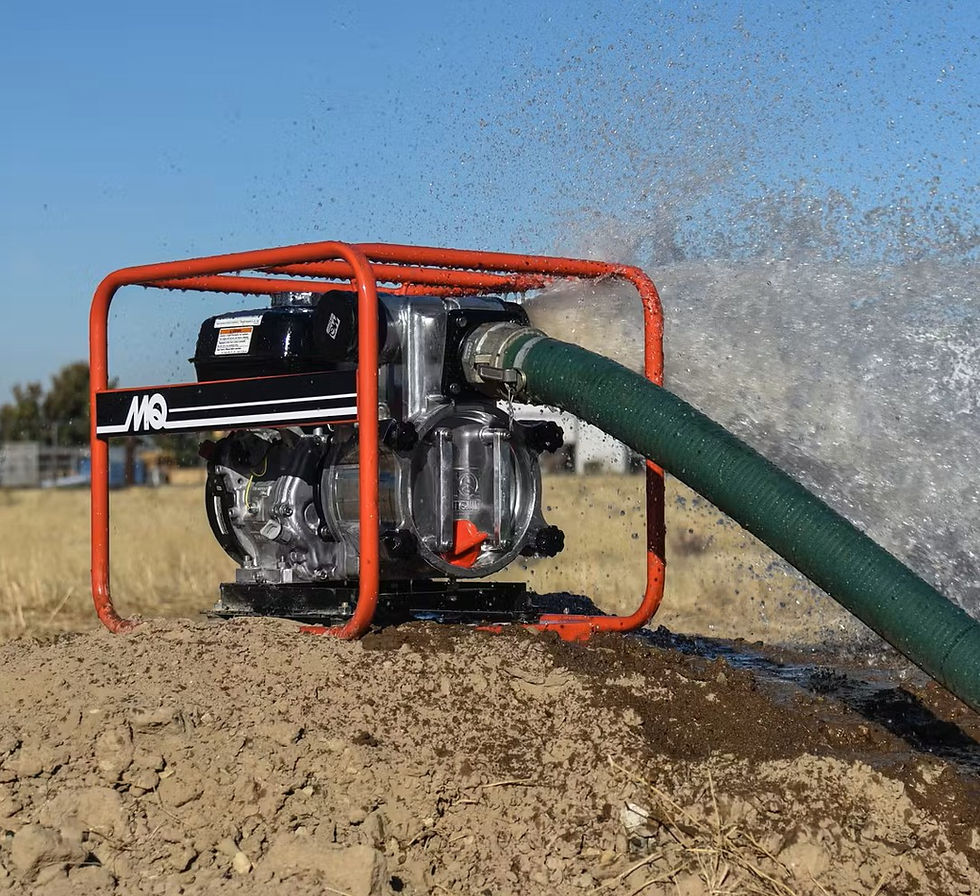
On the ground in South Sudan, equipment is routinely pushed to its limits. High sediment loads, debris, long run times, and limited workshop infrastructure all place heavy demands on pumping systems. Multiquip pumps are designed for precisely these conditions.
Key Advantages of Multiquip Pumps in Flood Response
High-Performance Dewatering and Trash Handling Multiquip’s dewatering and trash pumps are engineered to move large volumes of water quickly, even when that water contains silt, mud, and organic material. This makes them ideal for:
Dewatering flooded compounds and access routes
Managing water levels in drainage channels
Supporting emergency repairs to embankments and culverts
Durability in Harsh Environments Heavy-duty construction, robust impellers, and quality engine components mean Multiquip pumps can operate for extended periods in remote locations with minimal downtime. For humanitarian actors, this translates into fewer interruptions and more predictable operations.
Rapid Deployment and Field Maintainability Multiquip units are designed for fast setup and straightforward maintenance. Field teams can be trained to operate and service them with minimal technical background, which is critical when working with rotating staff, local partners, or surge deployments.
SLS integrates Multiquip solutions into broader pump portfolios, ensuring that NGOs and UN agencies can select the right configuration for each site. You can explore the range of dewatering, submersible, and trash pumps on the SLS Pumps page.
Aussie Pumps: Heavy-Duty Flood Mitigation at Scale
Aussie Pumps (Australian Pump Industries) has a proven track record in large-scale flood mitigation, including deployments into South Sudan for UN-led operations. Their high-capacity trash pumps are built for scenarios where water volumes are extreme and time is critical.
What Makes Aussie Pumps Suitable for South Sudan?
Very High Flow Rates: Certain Aussie Pumps models are capable of moving tens of thousands of litres per minute, making them ideal for protecting large areas, critical infrastructure, or high-density displacement sites.
Robust Trash Handling: These pumps are designed to handle debris-laden water, which is typical in South Sudanese flood environments where vegetation, silt, and waste are all present.
Proven Humanitarian Use Case: Aussie Pumps units have been shipped to South Sudan for UN flood mitigation projects, demonstrating their suitability for the operational and environmental context.
When integrated into a coordinated flood response strategy, Aussie Pumps provide the backbone for large-scale dewatering operations, while Multiquip and other units handle more localized or specialized tasks.
Integrated Logistics: Why Supplier Choice Matters
In a high-risk, low-infrastructure environment like South Sudan, the choice of pump supplier is as important as the technical specifications of the pumps themselves.
1. Regional Presence and Contextual Understanding
SLS is headquartered in Juba and operates across East and Central Africa. This regional presence translates into:
Faster deployment times for pumps and spare parts
Local knowledge of access constraints, customs procedures, and seasonal patterns
Established partnerships with air, land, and warehouse providers in Uganda and Kenya for last-mile delivery
This combination of equipment and logistics expertise is critical when floods cut off road access or when rapid deployment by air is required.
2. Compliance, Certification, and Donor Requirements
Humanitarian and development projects are governed by strict donor and compliance frameworks. SLS ensures that:
All pump equipment is ISO-certified and aligned with WHO and UN agency requirements.
Documentation and certification are available to support donor reporting and audit trails.
Equipment specifications match the technical standards required by major NGOs and UN agencies.
This reduces procurement friction and ensures that flood response projects can be implemented without delays caused by non-compliant equipment.
3. After-Sales Support and Warranty in Harsh Conditions
Flood response is rarely a short-term effort. Pumps may be required to run for weeks or months. SLS provides:
Warranty coverage tailored to harsh field conditions
Technical support and troubleshooting for remote WASH and pumping systems
Guidance on spare parts planning, preventive maintenance, and operator training
This end-to-end support model ensures that Multiquip and Aussie Pumps continue to deliver performance long after initial deployment.
Designing a Pump Strategy for Flood Response in South Sudan
For organizations planning or scaling flood response operations, pumps should be treated as part of a broader systems design, not as standalone assets. A robust strategy typically includes:
1. Risk and Site Assessment
Before deployment, SLS and its partners assess:
Topography and drainage patterns
Proximity to rivers, swamps, and seasonal water bodies
Access routes for equipment delivery and refuelling
Locations of critical infrastructure and community assets
This informs decisions about pump sizing, placement, and the number of units required.
2. Matching Pump Types to Operational Needs
Different scenarios demand different pump configurations:
High-capacity trash pumps (e.g., Aussie Pumps) for large-scale dewatering and flood defence
Medium-range dewatering pumps (e.g., Multiquip) for compounds, access roads, and smaller sites
Submersible pumps for confined spaces, pits, and flooded structures
By combining multiple pump types, response teams can address both macro-level flood mitigation and micro-level site management.
3. Integrating Pumps with WASH and Shelter Interventions
Pumps are most effective when integrated with:
WASH infrastructure rehabilitation (latrines, boreholes, drainage)
Shelter planning and site layout, including drainage corridors and safe siting of communal facilities
Water treatment and distribution systems, where pumped water is treated and then supplied safely to communities
SLS supports this integration by aligning pump deployments with WASH equipment and emergency relief supplies, ensuring that water is not only moved but also managed safely.
4. Training and Capacity Building
Sustainable flood response requires local capacity. SLS works with partners to:
Train operators on safe pump operation, troubleshooting, and routine maintenance
Develop simple SOPs (Standard Operating Procedures) for start-up, shutdown, and emergency response
Build local ownership, so that communities and field teams can manage equipment beyond the initial deployment phase
Why Partner with Specialized Logistics Solutions (SLS)?
For organizations operating in South Sudan and the wider region, SLS offers a combination of:
Proven high-risk logistics capability in conflict and post-disaster environments
Specialized pump portfolios featuring Multiquip and Aussie Pumps
Integrated WASH, warehouse, and NFI solutions that support comprehensive flood response
Regional warehousing and last-mile delivery capacity across South Sudan, Uganda, and Kenya
From initial assessment and equipment selection to delivery, commissioning, and ongoing support, SLS acts as a strategic partner rather than a simple supplier.
You can explore SLS’s broader capabilities and product range via:
Conclusion: From Reactive Response to Resilient Systems
Floods in South Sudan will continue to pose a serious humanitarian and operational challenge. However, the impact of these events can be significantly reduced when organizations invest in the right combination of equipment, logistics, and local capacity.
Industrial pumps—especially high-quality solutions from Multiquip and Aussie Pumps—are central to this effort. When deployed strategically and supported by a partner with deep regional expertise like Specialized Logistics Solutions (SLS), pumps become more than hardware; they become instruments of resilience, enabling communities, NGOs, and UN agencies to protect lives, assets, and critical infrastructure.
For NGOs, UN agencies, and government institutions planning or scaling flood response operations in South Sudan, partnering with SLS offers a direct pathway to reliable, compliant, and field-proven pumping solutions.
Comments